Shopify subscription store credit renewal testing should prove how one amount due connects to each funding leg. In our fictional 40-unit renewal, 12 units of eligible credit and a 28-unit saved-method payment cover the same renewal. The receipt needs one matching identifier, not three unrelated totals.
This guide gives merchants a sample receipt ledger, a funding chart, an evidence map and four CSV tools. The numbers are fictional. They do not report a live store, processor settlement or accounting treatment. A separate demo script asks a vendor to show opt-out, currency, failure, retry and refund behavior before promising it to customers.
Shopify subscription store credit renewal testing: check the release status
Shopify’s 19 November announcement documents optional store-credit support in API 2027-01. For eligible subscriptions where the customer opts in, credit is applied before the remainder is charged to the saved method. Existing plans and contracts are unchanged by default. That does not establish availability in every merchant’s app or store.
The 2027-01 release notes identify this version as a release candidate for development testing until it becomes stable on 1 January 2027. As of this report’s 24 November research date, a buyer should ask which API version and implementation a vendor actually uses. A news announcement is not a completed integration test.
Reconcile the fictional 40-unit renewal
Start with renewal DEMO-R001 and an amount due of 40 DEMO units. The credit leg is CR-001 for 12 units. The saved-method leg is PM-001 for 28. These identifiers and units are invented solely for the worksheet. They are not a real customer contract, currency or processor reference.
The two funding amounts sum to 40: 12 + 28. Credit represents 12 divided by 40, or 30%; the saved method represents 70%. The 40-unit amount-due row is a control total. It must not be added as a third payment, which would incorrectly turn the funding sum into 80.
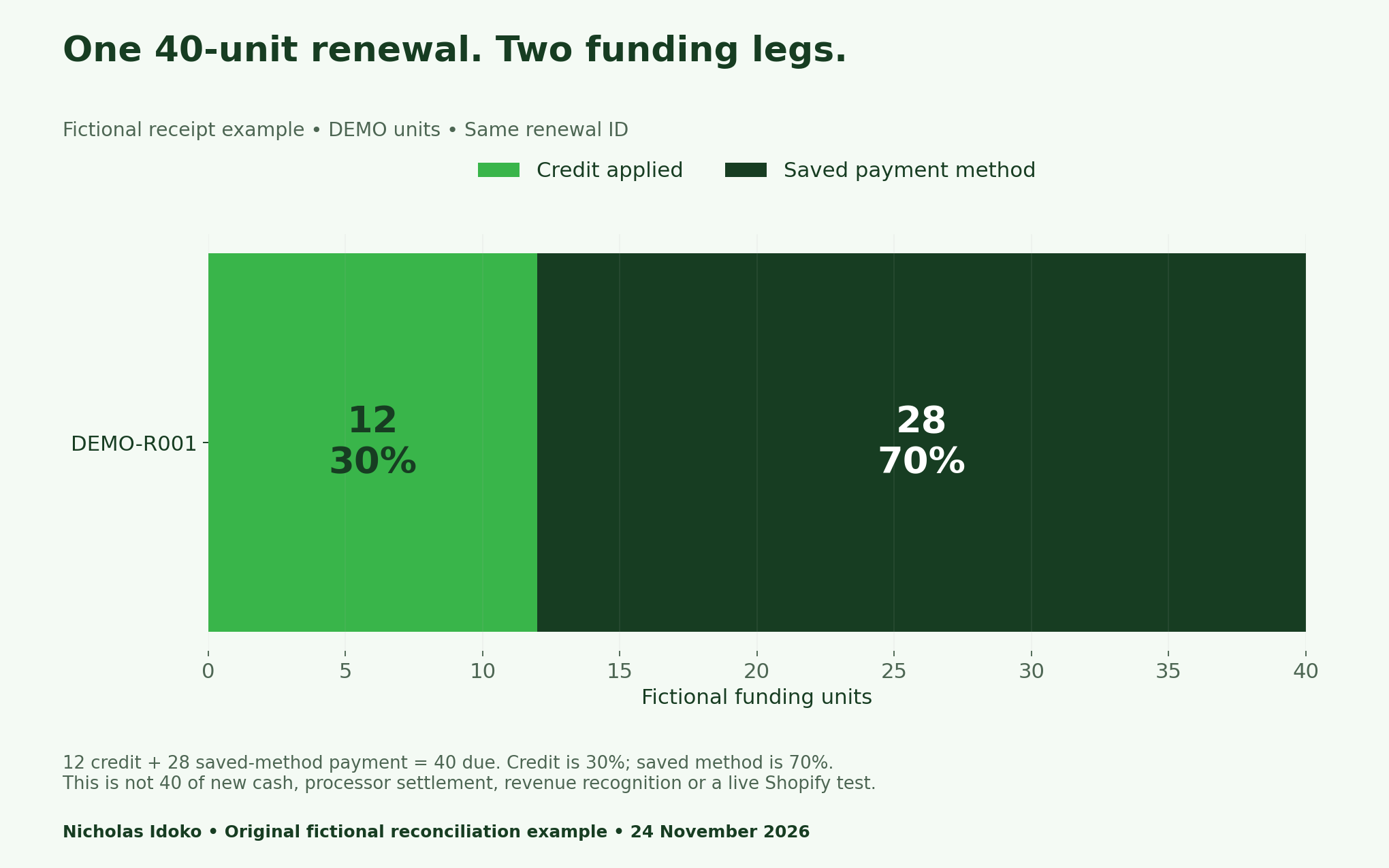
Credit applied and cash received answer different questions. The 12-unit credit leg is not a new bank deposit. Likewise, a successful 28-unit payment does not by itself establish the net amount or timing of settlement after fees. Keep those records separate and reconcile the actual processor and bank evidence.
Ask the receipt to show status as well as amount
A useful receipt or supporting record should identify the renewal, the amount due, currency, credit transaction, payment attempt and final states. Distinguish a requested charge from a successful payment. A polished receipt that only shows an attempted amount can mislead both staff and the customer.
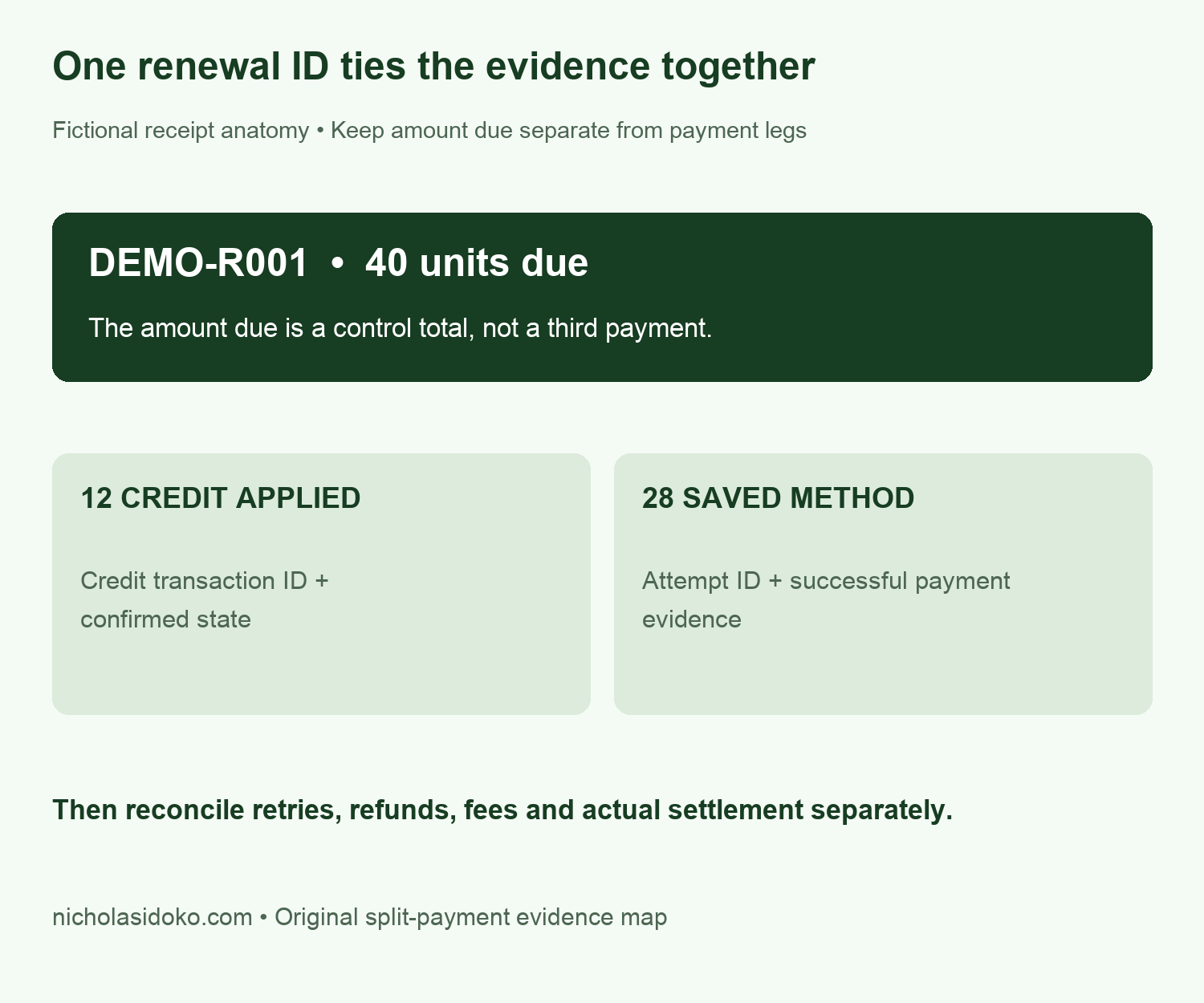
Use the blank worksheet to record the observed identifiers and states. When an operation fails or remains pending, keep that state visible. Do not label the renewal paid merely because its intended payment legs add up. Arithmetic consistency is necessary for reconciliation, but it is not evidence that both legs completed.
Treat opt-out and wrong currency as demonstration cases
Ask the vendor to show an eligible opt-in case first, then repeat with opt-out. Record the setting and actual sequence. The script asks what happened; it does not assume a particular fallback or promise how every integration behaves. Keep the customer’s choice tied to the contract being renewed.
Next, use synthetic balances in a different currency from the renewal. Ask the vendor to show eligibility, handling and the resulting receipt. Do not invent an exchange rate or assume an automatic conversion. A merchant needs a demonstrated answer for the store and app configuration it intends to use.
Separate a failed remainder charge from a confirmed payment
For a diagnostic example only, suppose 12 units remain recorded as applied credit but the 28-unit payment has not succeeded. Confirmed funding is then 12 and the unreconciled difference is 28. This calculation assumes that credit state only for illustration. It does not claim Shopify retains credit after a failed charge.
The vendor should demonstrate whether credit is applied, released, reverted or left in another state when the saved-method leg fails. Capture the actual transaction and attempt records. The worksheet leaves that outcome open because the failure path must be observed, not guessed from the successful example.
Inspect retries and partial refunds before launch
Use one renewal identifier across repeated attempts and retain distinct attempt identifiers. Ask whether the retry creates another credit debit or payment, resumes an earlier operation, or ends in a documented failure. Reconcile the final state before declaring that duplicate charging is prevented. A stable identifier helps investigation but does not prove idempotency on its own.
For a partial refund, record the amount, destination, credit-account effect and payment-method effect. Do not assume that a refund returns to one particular source or follows a fixed allocation order. The six-case demo script makes this a question to verify in a development environment before customer-facing promises are written.
Translate the credit policy into an integration scope
Our e-commerce development services can help connect checkout policy, customer records and reconciliation evidence. Bring the subscription journey, when customers may opt in and how staff currently resolve payment disputes. The scope should include failure evidence as well as the successful checkout.
Share your subscription checkout and credit policy. We’ll help scope the integration and its acceptance tests. For a separate example of keeping authorization distinct from populated fields, see our AI support-form approval guide.
Methods, limits and four downloadable tools
We checked Shopify’s announcement and release notes on 24 November 2026. The receipt, identifiers, units and diagnostic failure calculation are fictional. No live contract, billing attempt, store balance, refund or settlement was executed. The demo questions do not establish real product behavior, and this is not accounting or tax advice.
- Fictional same-renewal receipt ledger (CSV)
- Funding shares and diagnostic calculations (CSV)
- Six-case subscription-credit demo script (CSV)
- Blank renewal reconciliation worksheet (CSV)
Suggested citation: Nicholas Idoko, “Subscription Store Credit: What Should the Renewal Receipt Show?”, 24 November 2026. Cite Shopify for its announced feature and this article for the original fictional ledger and test script. Explore Research & Reports for related buyer tools.
Support our research
Found this report useful? Your contribution helps us produce carefully sourced research, clear charts and practical resources, freely available to everyone. Choose a one-time amount that works for you.


