An AI customer support form approval workflow should separate a proposed value from permission to act. A filled rebooking date is not proof that the customer chose it. A populated address is not proof that it belongs to the right person. Buyers need evidence at each handoff before accepting automation.
This guide supplies a ten-case procurement demo, a coverage chart, an approval swimlane and four CSV tools. The cases are synthetic test designs, not measured results. They show what to ask a vendor to demonstrate, without claiming that a particular product passed, failed or saved a stated amount of time.
AI customer support form approval workflow: what changed
AWS’s 23 November announcement says Amazon Connect Customer AI agents can populate guide fields on load and suggest changes during a conversation. Staff can review, accept, reject and edit. This describes a capability, not accuracy in your business or permission to execute a customer action.
The autofill guide distinguishes automatic acceptance from individual review. New components can have autofill and auto-accept enabled by default; field controls and permissions matter. Check the actual configuration rather than assuming every value waits for a human click. The guide limits this form population feature to voice and chat contacts.
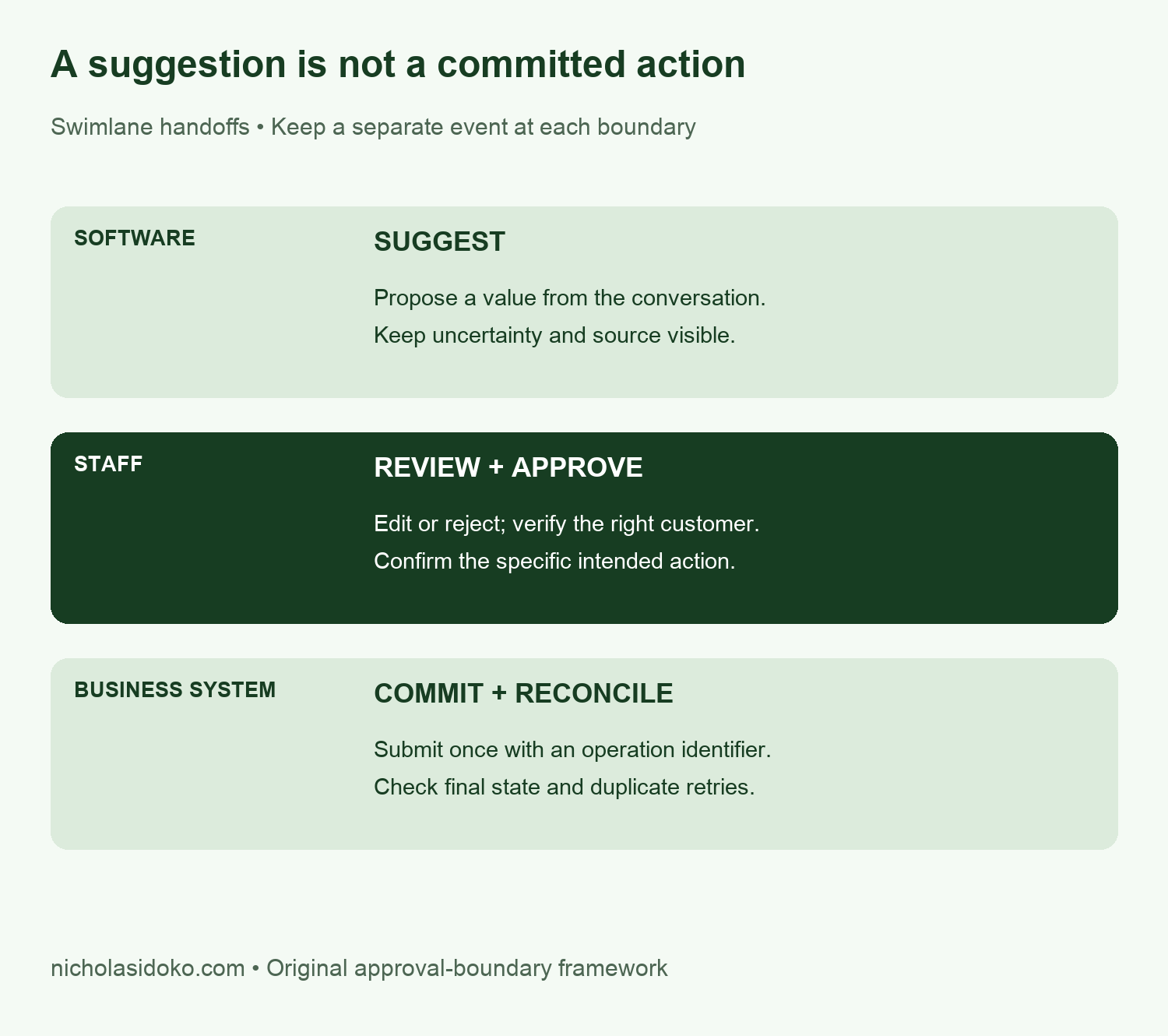
A separate interactive-response announcement discusses reviewing information and confirming actions through connected workflows. Keep field population and a downstream transaction separate in your acceptance plan. A confirmation in one interface should not silently authorize a different operation.
Start with ten cases that expose different failure modes
Our script contains two clear baseline requests, three field-correction cases, two identity-uncertainty cases, one missing-consent case, one duplicate retry and one withdrawal. Each case has one primary family so the chart sums to ten. Secondary risks may overlap. These counts describe coverage, not real customer frequency.
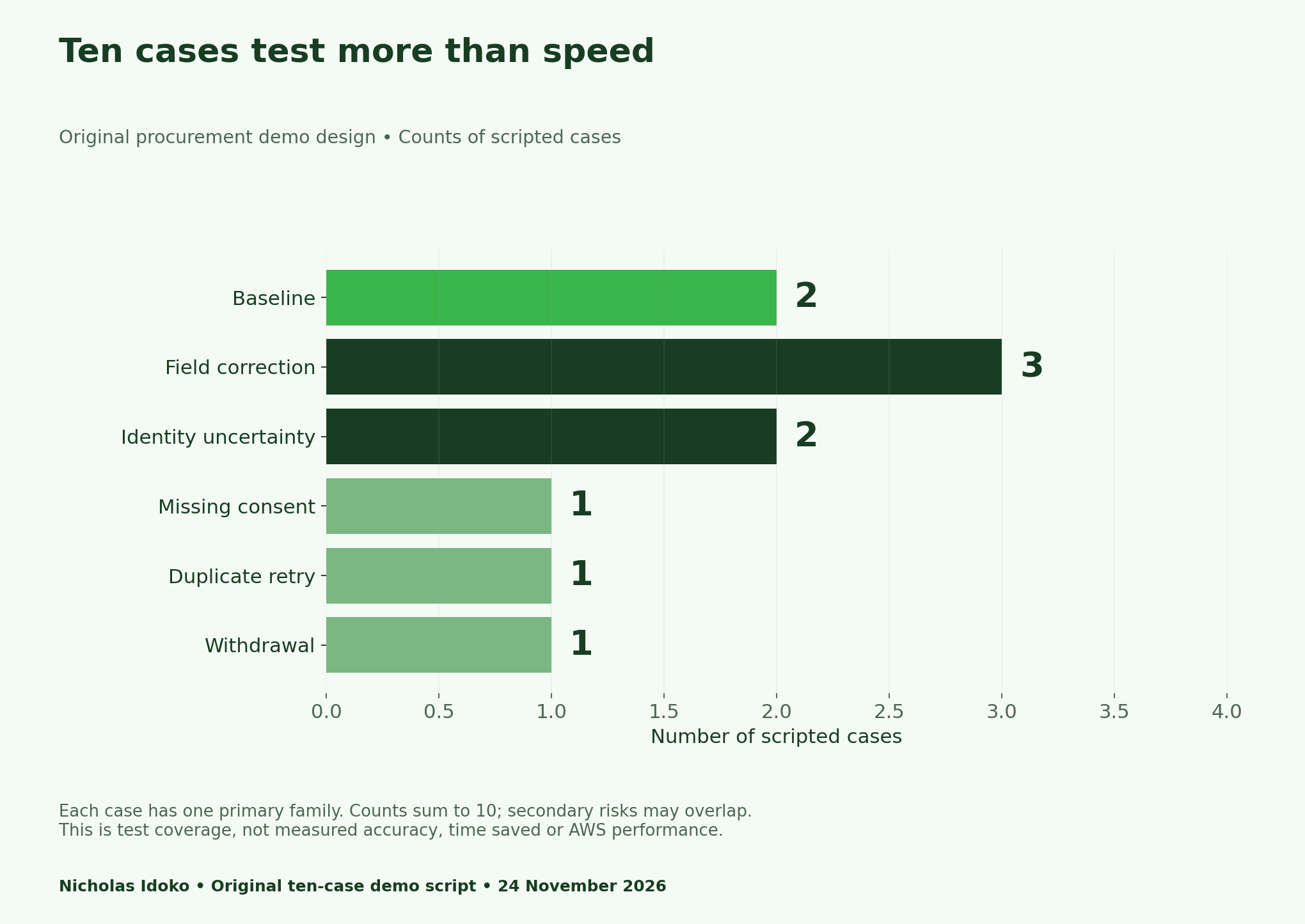
The clear rebooking and service requests establish a basic path. The corrected date, updated address and ambiguous date format test whether the final confirmed detail replaces an earlier or uncertain interpretation. Use invented references and addresses throughout the demo. Do not load real customer records merely to make a sales demonstration feel realistic.
The uncertain match and similar-name cases test a different boundary. A plausible field value may still refer to the wrong customer. Require the vendor to show how staff identify the correct record and prevent cross-customer action. A fluent explanation does not replace record-matching evidence.
Keep suggestion, edit, approval and outcome in separate columns
The event ledger records what software proposed, what staff changed, what they approved and what the business system finally did. Preserve the original suggestion when a person edits it. Otherwise, a correct final field can hide an incorrect first entry, and the buyer loses the evidence needed to assess staff effort.
Also record uncertainty. A field without enough information should remain unresolved until the missing detail is established. Treat guessing a required value as a separate test failure. A missing value and a confidently wrong value can require different remedies, even if both delay the request.
Test consent, withdrawal and retries before measuring speed
In the missing-consent case, the expected rule is no action without the required authorization. The worksheet does not prescribe a universal legal consent standard; the business must define the permission needed for its actual process. Record the scope and evidence of that approval rather than inferring it from a completed form.
In the withdrawal case, the customer changes their mind before commitment. Ask the vendor to show the final state and any actions already initiated. A refreshed field is not proof that an earlier action was canceled. The outcome evidence should identify which operation, if any, actually occurred.
For a repeated submission, retain the request and operation identifiers. Demonstrate whether a retry creates a second action or resolves to an existing one. Do not assume a vendor or integration provides idempotency. The demo script states an expected boundary; only a run can establish the observed behavior.
Score errors and corrections alongside elapsed time
Agree a reference answer for each synthetic case before running it. Record false suggested fields, staff corrections, missing information and unauthorized commitments separately. Define every denominator. A field-level accuracy calculation is not the same as the share of cases ending with a correct action.
Next, measure elapsed time with a declared start and end. Use the same case mix when comparing approaches. Report unresolved or stopped cases rather than dropping them to improve an average. Faster entry that causes a wrong action is a different result from a safe reduction in staff effort.
This article reports no accuracy percentage or time saving because we have not run a product evaluation. The coverage chart explains why ten selected cases are present, while the blank event ledger is ready for observations. Keep that distinction when sharing a procurement summary with colleagues.
Bring one repetitive process to a software scope discussion
Our custom software services can help map an existing support process into reviewable handoffs. Start with the repetitive task, the records it touches and the cost of a wrong action. The first scope should identify what software may suggest and what still needs staff approval.
Share one repetitive support process and where mistakes currently cost you money. We’ll map what software can suggest and what staff should still approve. For release evidence under a different kind of risk, see our performance sign-off guide.
Methods, limitations and four downloadable tools
We checked the linked AWS sources on 24 November 2026. All ten case descriptions and expected gates are original synthetic designs. We counted primary families from the case script. No AWS instance, customer transcript or third-party product was tested, and no independent accuracy, safety or savings claim is made.
- Ten-case synthetic procurement demo script (CSV)
- Test-family coverage counts and denominator (CSV)
- Blank suggestion-to-outcome event ledger (CSV)
- Measures, denominators and approval-gate dictionary (CSV)
Suggested citation: Nicholas Idoko, “AI Support Forms: Separate Suggestions From Permission to Act”, 24 November 2026. Cite AWS for its announced feature and this article for the original ten-case demo and handoff framework. Explore Research & Reports for related buyer tools.
Support our research
Found this report useful? Your contribution helps us produce carefully sourced research, clear charts and practical resources, freely available to everyone. Choose a one-time amount that works for you.


