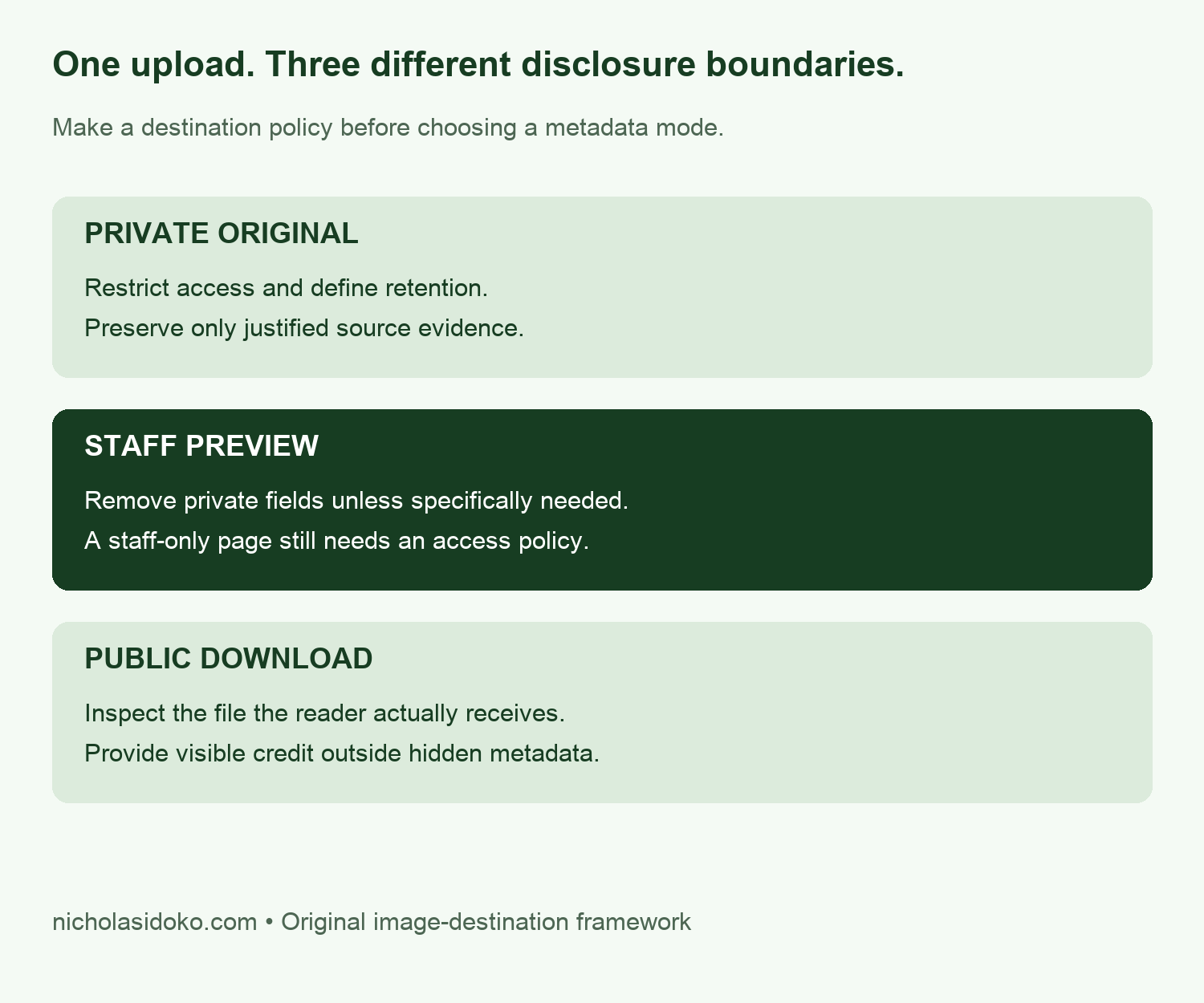
Image metadata privacy requirements for apps start with a destination decision. A private original, a staff preview and a public download do not need the same hidden fields. Keeping creator credit is a different choice from exposing a location. A familiar-looking picture can carry both, even when neither appears on the page.
This guide provides a three-destination policy matrix, an actual local export check, an infographic and four CSV tools. We also supply a ZIP containing synthetic public JPEG, WebP and AVIF files. The demonstration uses fake information and a local image library. It is not a test of Cloudflare’s service or a compliance certification.
Image metadata privacy requirements for apps: separate capability and policy
Cloudflare’s 23 November Images update expands preservation support. Its table permits JPEG-to-WebP EXIF and XMP output, while AVIF output supports EXIF but not XMP. That is a product-specific capability table. It does not decide which fields your application should expose or establish every codec’s capabilities.
The metadata parameter reference distinguishes preservation modes and notes important exceptions. In particular, an unchanged source response can retain its embedded data. Therefore, a configuration name alone is insufficient acceptance evidence. Check the actual response that each user can download.
Map the original, staff preview and public copy
Begin with the original upload. Identify why it is retained, who can access it and when it should be deleted. A restricted source may have a legitimate evidence purpose, but that does not authorize every member of staff to retrieve it. Keep retention and access decisions separate from image quality.
Next, specify the staff preview. A reviewer may need to confirm the image subject or approved attribution without seeing location information. A staff-only page does not make an unrestricted underlying file private. Check both the page permission and direct file access under the intended role.
Finally, define the public download. Decide which fields should remain and how visible attribution will appear. Do not rely on hidden metadata as the only way to credit a creator. A reader may view a screenshot, a transformed copy or a format that does not retain the field you expected.
What our synthetic export test actually did
We drew a simple leaf fixture locally. Its synthetic original contains a test creator, EXIF copyright, XMP and a fake GPS marker at zero degrees latitude and longitude. That marker is deliberately invented; it is not the location of a photograph or a real person. The original remains in our local research archive.
We then created three public exports with Pillow 11.3.0. Each explicitly keeps only an EXIF copyright field. We reopened the JPEG, WebP and AVIF files and inspected their decoded metadata. GPS and EXIF Artist were absent; EXIF copyright remained. XMP was absent from all three public fixtures.
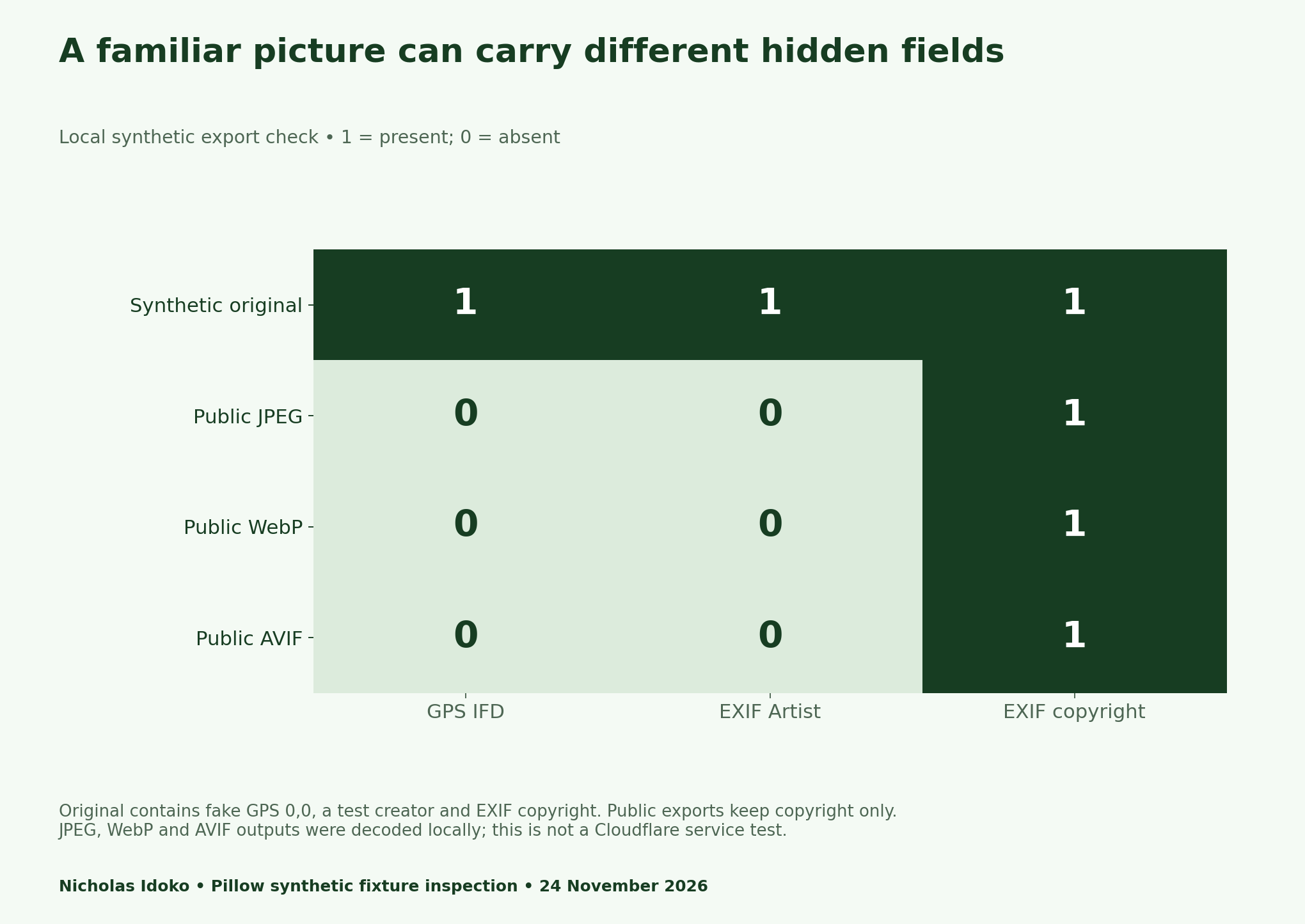
The matrix records three named field-presence checks across four files. It is not a privacy score. Absence of those fields does not establish that a real photo is anonymous: visible content, filenames, other metadata and application records may reveal information too. Keep the scope of the observation explicit.
Download the outputs instead of trusting the page
The ZIP below contains the three synthetic public exports and a manifest. It excludes the synthetic private original. Open the extracted files with a metadata-aware tool and compare the named fields with the CSV. A normal image viewer may show the leaf while hiding all of the information being tested.
Download the three synthetic public export fixtures and manifest (ZIP)
Visible attribution for these fixtures: synthetic leaf demonstration by Nicholas Idoko. The credit appears here independently of the file metadata. This is a teaching example, not a statement that an embedded copyright field establishes ownership, consent or a license to publish someone else’s image.
Build acceptance tests around recipients and actual files
Use a synthetic fixture for a vendor demonstration. Record the source identifier, destination, requested format, transformation version and expected field policy. Then download as the intended recipient, inspect the result and retain its hash. If negotiation changes the format, check the file received rather than assuming the URL suffix describes it.
Also test the path that returns an original or bypasses a transform. A clean preview does not prove a public original link is safe. After changing a policy, consider cached copies and previously shared URLs. Document what was checked rather than declaring a universal purge from a single successful download.
Content Credentials address provenance through a separate mechanism. Do not describe EXIF stripping as proof of consent, authenticity or regulatory compliance. If provenance is important, define that requirement explicitly alongside the privacy and attribution decisions.
Turn an upload workflow into a development scope
Our custom software services can help specify the copy that each user should receive. Bring an outline of who uploads, reviews, downloads and removes images. The first useful artifact is a destination matrix with access rules, not a blanket promise to keep or strip everything.
Send a description of who uploads, views and downloads your images, without sending sensitive originals. We’ll scope the rules each copy needs. For another release-evidence example, see our performance acceptance guide.
Methods, limits and four CSV downloads
We checked the linked official sources on 24 November 2026. The local fixture checks inspect GPS IFD, EXIF Artist, EXIF copyright and XMP presence. They do not exercise Cloudflare settings, authenticate a photo or establish legal compliance. A real implementation needs tests of its actual download paths and the relevant data-handling obligations.
- Local synthetic export checks with file hashes (CSV)
- Three-destination policy matrix (CSV)
- Blank image-download acceptance register (CSV)
- Source-format and evidence-scope register (CSV)
Suggested citation: Nicholas Idoko, “Customer Photo Downloads: Decide Which Metadata Each Copy Keeps”, 24 November 2026. Cite Cloudflare for its documented capabilities and this article for the original policy matrix and local synthetic export inspection. Explore Research & Reports for related tools.
Support our research
Found this report useful? Your contribution helps us produce carefully sourced research, clear charts and practical resources, freely available to everyone. Choose a one-time amount that works for you.


