A database restore test checklist asks a business question: after data loss, can your team recover orders and resume the work you agreed matters? A successful backup notification does not answer that question. Before renewing a maintenance plan or accepting a custom portal, ask for an isolated exercise with synthetic orders, a named owner and evidence you can review.
Database restore test checklist: why ask now?
On 16 November 2026, AWS announced logically air-gapped vault support for Amazon RDS DB instances. Its announcement describes protected backups and direct restores from a shared account under supported conditions. Availability covers most regions where the relevant vault and RDS services are available. This is a platform capability, not a measured recovery time for your business.
The AWS launch explanation adds an important boundary: the isolated RDS copies are snapshots, while continuous point-in-time recovery stays in a standard vault. It also describes source-account, region and encryption considerations. Your technical team should verify the supported configuration; a product headline alone cannot establish that the intended recovery path is available for your database.
You do not need to use AWS to apply the checklist below. The original exercise plan is deliberately about evidence and business acceptance. We have not run a restore test for this report, so there are no published recovery benchmarks or observed results. The scorecard stays blank until an authorised team actually completes the exercise.
Agree two targets before anyone starts the clock
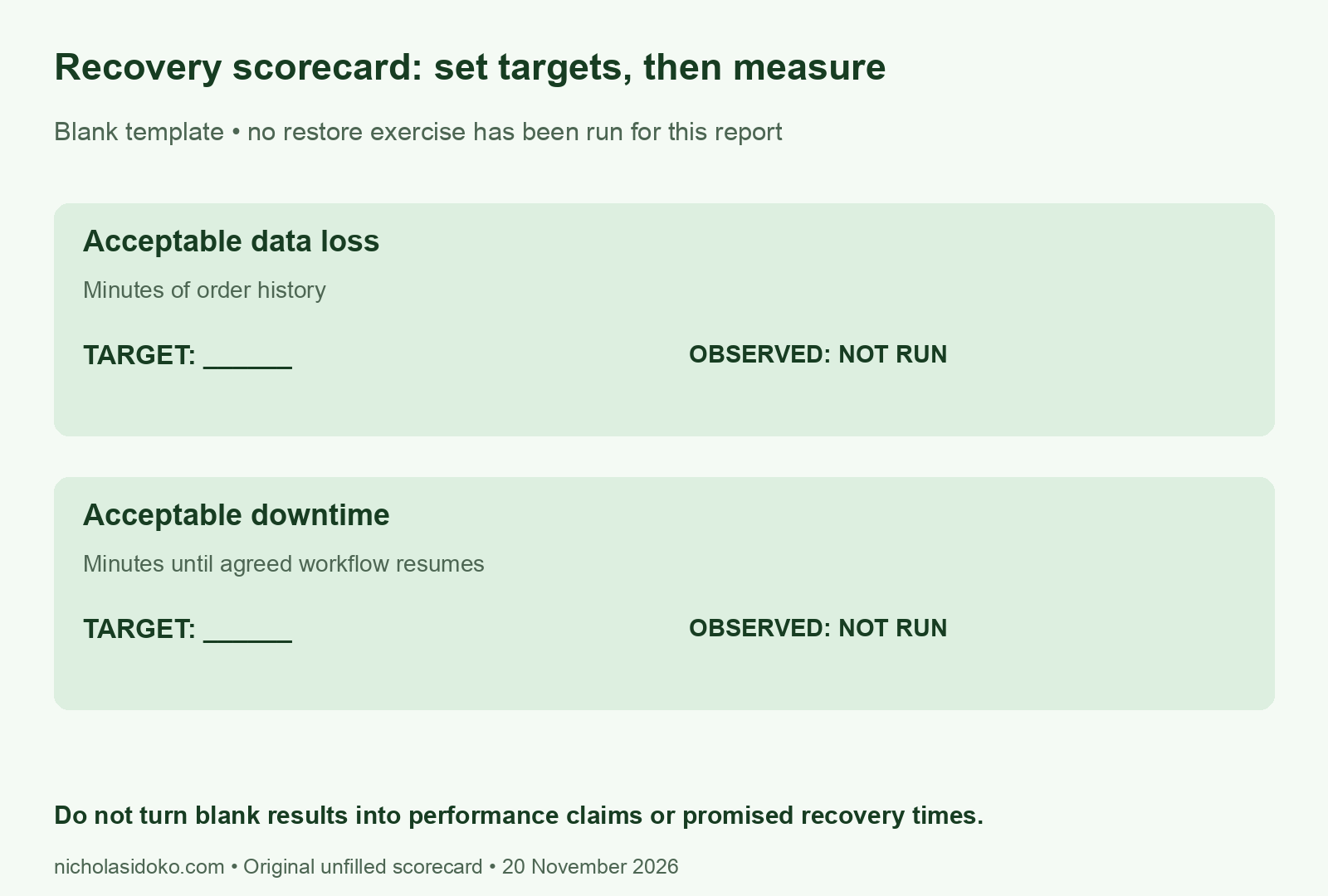
First, decide how much missing order history the business can tolerate. This is a data-loss question, often expressed as a recovery point objective. A backup schedule may be relevant, but it does not by itself show which committed order the restored system will contain. Keep the target beside the last recovered order reference and its timestamp.
Next, decide how long the agreed operation can be unavailable. This is a downtime question, often expressed as a recovery time objective. The endpoint needs a practical definition. A database becoming available may happen before staff can search an order, check its status and continue the chosen workflow.
Do not copy another company’s target into your support contract. Instead, have the business owner explain the consequences of missing history and interrupted work. Then ask the supplier what scope, dependencies and cost are needed to test those requirements. An aggressive target without an agreed test is still an assumption.
Measure data loss and downtime separately
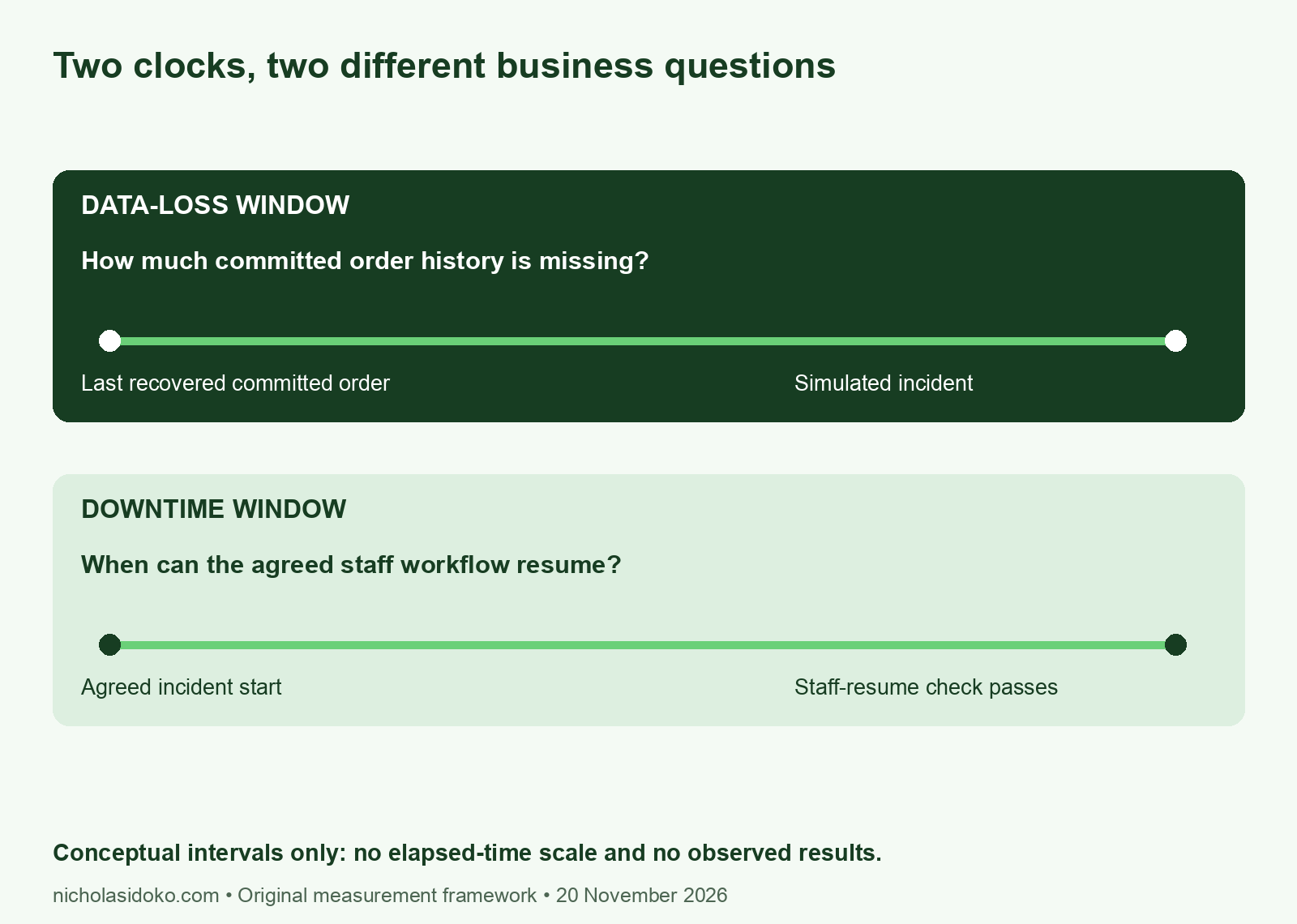
Use timestamps with a recorded timezone. For the data-loss window, compare the simulated incident time with the latest committed synthetic order that was actually recovered. For the downtime window, use the agreed start and the agreed point at which the staff workflow can resume. Keep both definitions in the event log.
A single “restore finished” timestamp can hide a gap between those questions. For example, the database may contain older orders while a required file, queue or linked service is still unavailable. That is a reason to document dependencies, not to assume a failed system or publish an invented delay.
Run a safe exercise with synthetic orders
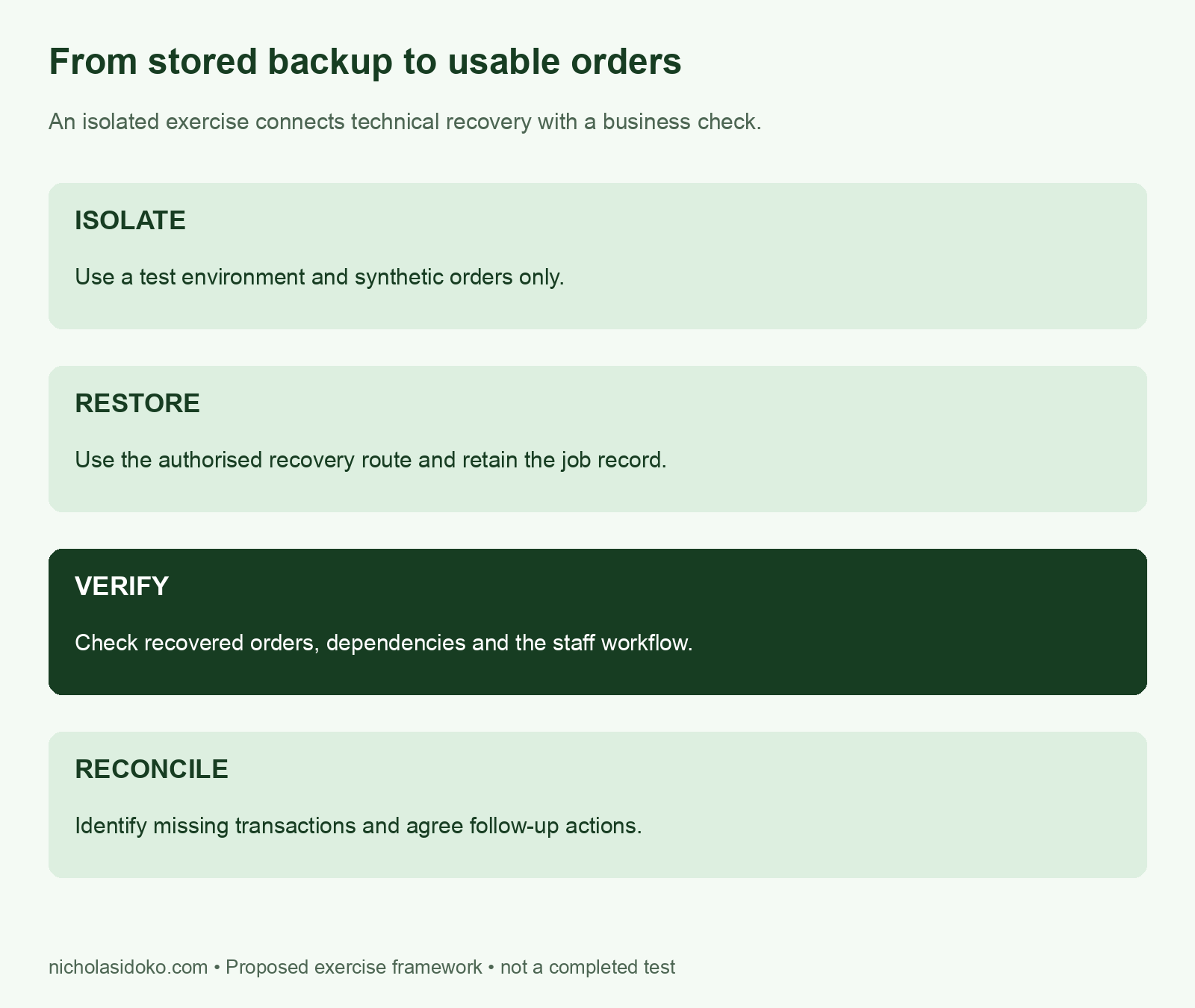
Prepare an isolated environment and a small manifest of clearly fictional order references. Record their synthetic commit times and expected states. Agree what the test may do before it begins. In particular, ensure it cannot send genuine customer notifications, create real charges or trigger live fulfilment. This article does not instruct anyone to restore over production.
During the exercise, retain the recovery job reference and the event log. After the restore, compare the recovered records with the manifest. Then ask the authorised test user to complete the agreed staff workflow. Record what worked, what remained unavailable and which dependency caused an unresolved gap.
Finally, reconcile the synthetic orders that are missing or inconsistent. Assign an owner to each follow-up action and record how the result will be checked. A useful report can show an unresolved result honestly; it should not convert “not tested” into “passed” because a backup exists.
Download the database restore test checklist tools
- Blank target-versus-observed recovery scorecard (CSV)
- Synthetic order manifest template (CSV)
- Restore exercise event log (CSV)
- Recovery dependency and follow-up register (CSV)
Methodology and a practical next step
We checked the AWS announcement and launch explanation on 20 November 2026. All scorecards, diagrams and worksheets are original planning tools. No customer database, live order dataset or measured recovery time was used. The synthetic manifest contains placeholder references only; timestamps and results remain empty. Publish benchmark numbers only after a documented exercise has produced them.
Our support and maintenance services can start with the operation you need to recover. The checkout sign-off checklist covers a related acceptance decision. Tell us how much downtime and lost order history your business can tolerate. We can use those requirements to scope a recovery test without asking you to send database credentials or customer records.
Support our research
Found this report useful? Your contribution helps us produce carefully sourced research, clear charts and practical resources, freely available to everyone. Choose a one-time amount that works for you.


