App Store age rating shared location questions belong in the scope of an iPhone app before design starts. A founder may describe a feature as “just a map”, while the proposed product lets one person see another person’s real-world location. Those are different specifications. Before signing a development quote, document who sees whose location, why they see it and when access ends.
App Store age rating shared location: what changed
Apple’s 19 November 2026 App Store Connect release notes list Shared Location and Dating and Relationships as new questionnaire descriptors. In Brazil, declaring them assigns A16 and A18 respectively. Apple requires the declarations with an app update or questionnaire change, and for all apps by 12 January 2027. These Brazil ratings should not be presented as a worldwide rule.
An earlier Apple announcement dated 2 November describes Shared Location as real-world location being shared with another person or group. It also identifies a possible official lower-rating route in Brazil, including a parent-child example, through the Brazilian authority. That is not an automatic exemption. The earlier announcement says 16 November for the rollout; the later release notes say 19 November. We retain that date distinction rather than silently treating the announcements as identical.
For a product buyer, the next step is to review the intended behaviour against the current questionnaire and the markets you plan to serve. An age-rating declaration is not a promise that Apple will approve the app. Nor does a screenshot of a map settle the classification of everything that happens behind it.
Compare three location features before asking for a price
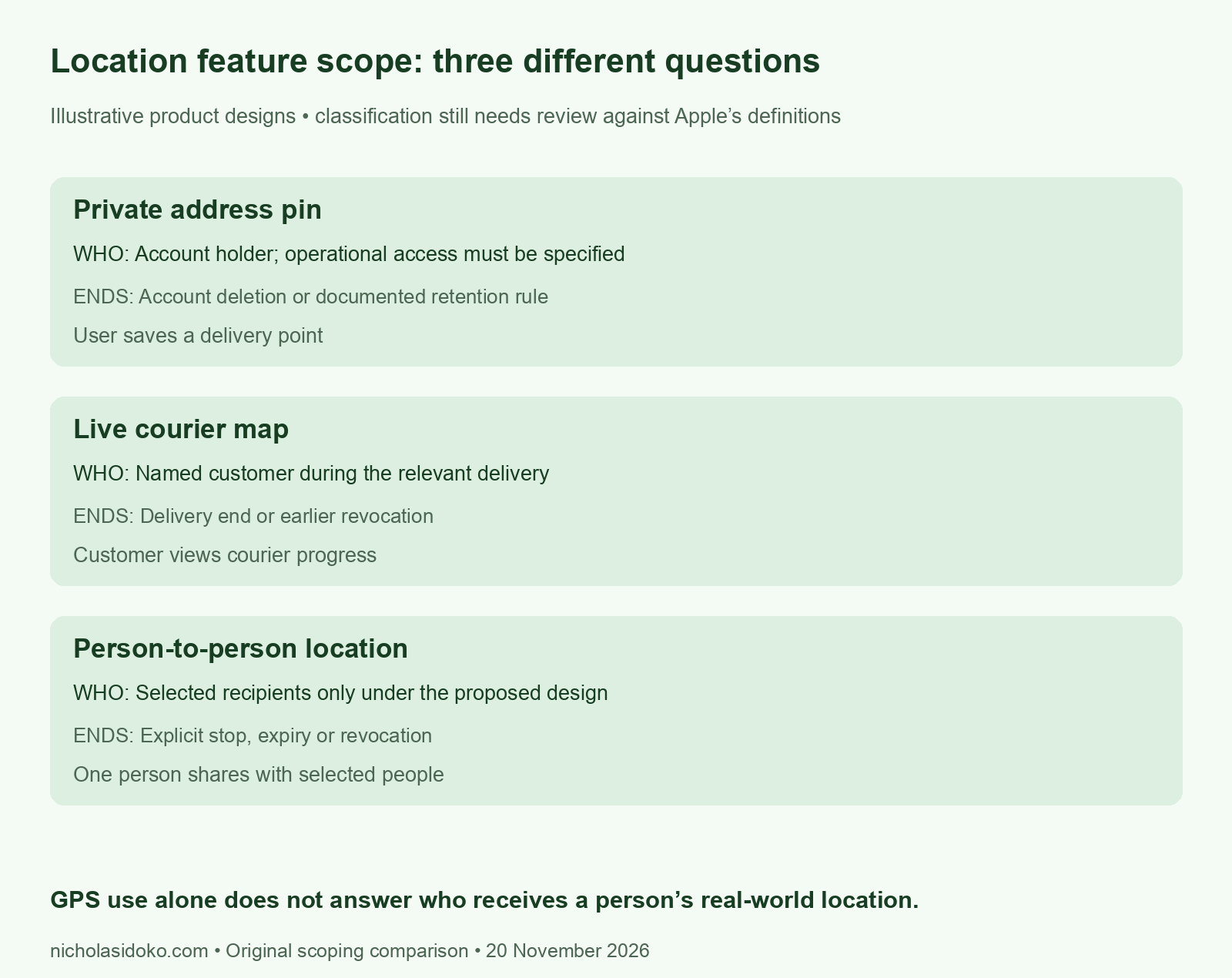
First, consider a private address pin. A user might save a delivery point for their own account. However, the word “private” does not tell a supplier whether staff, a courier or another customer can also receive it. Specify every intended recipient. Then review the actual design, instead of assuming that a convenient feature name answers the questionnaire.
Next, consider a live courier map. The proposed recipient may be a particular customer during an active delivery. Ask whether the view shows a live position, a rough area or only a delivery status. Decide when that view starts and stops. A map available indefinitely after delivery is a different access rule from a view that ends with the job.
Finally, consider person-to-person sharing. The specification should say who can invite a recipient, whether an invitation expires and how the person sharing can stop access. If the product also includes relationship features, review those separately. Do not assume a location answer covers the rest of the app.
Keep Brazil’s rating outcome separate from other markets
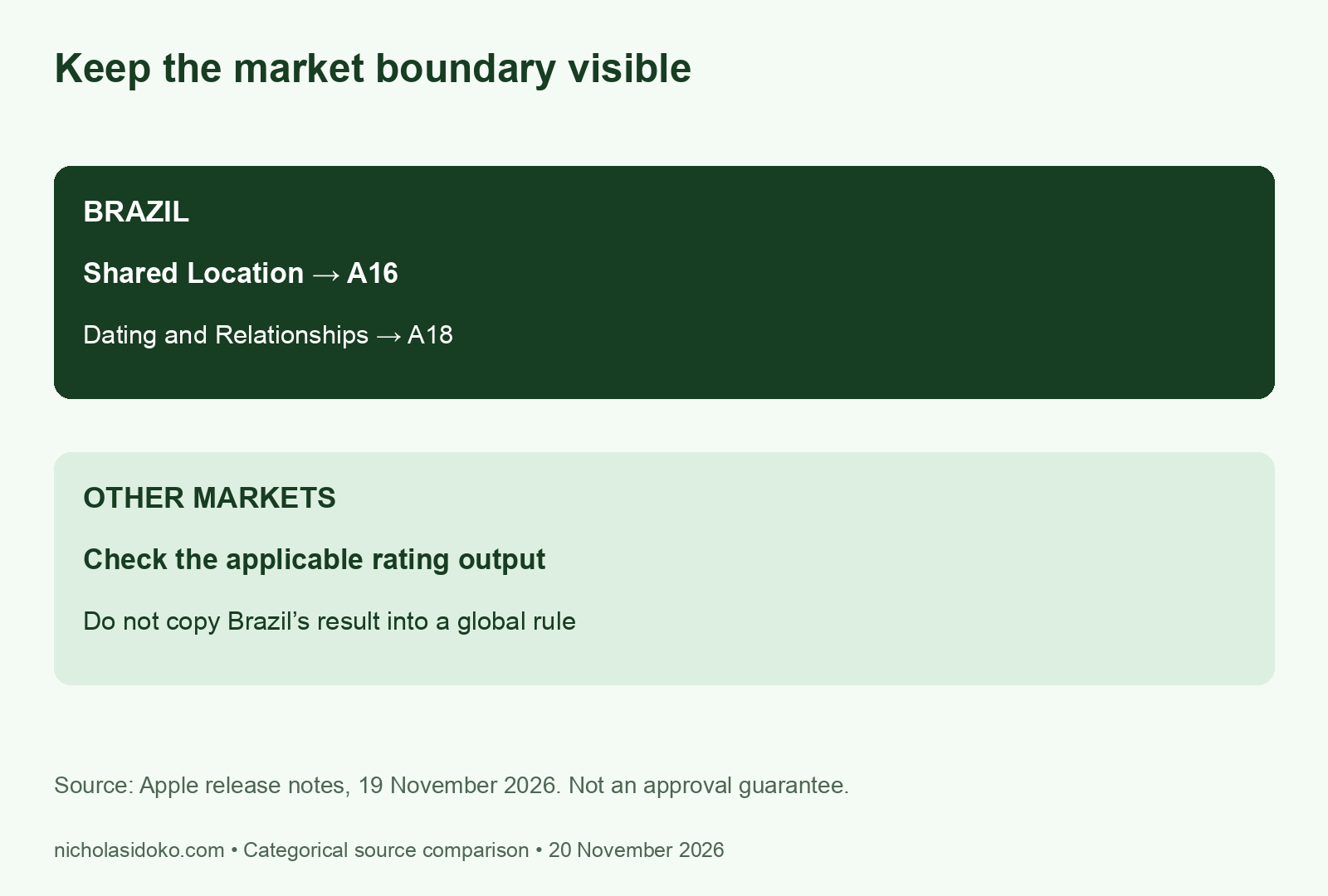
A launch-market register helps stop one country’s result becoming an unsupported global claim. Give each intended market its own row. Record the feature reference, the current definition checked, the questionnaire answer and the rating output reviewed. Leave an unresolved question visible until someone has evidence to close it.
This also changes how you compare proposals. A supplier should identify the assumptions behind the quoted scope. If the estimate assumes one recipient and one launch market, adding broader sharing later may affect the work required. Ask for the review point before the design is treated as final, without promising a particular legal or store-review result.
Build an ending into the sharing feature
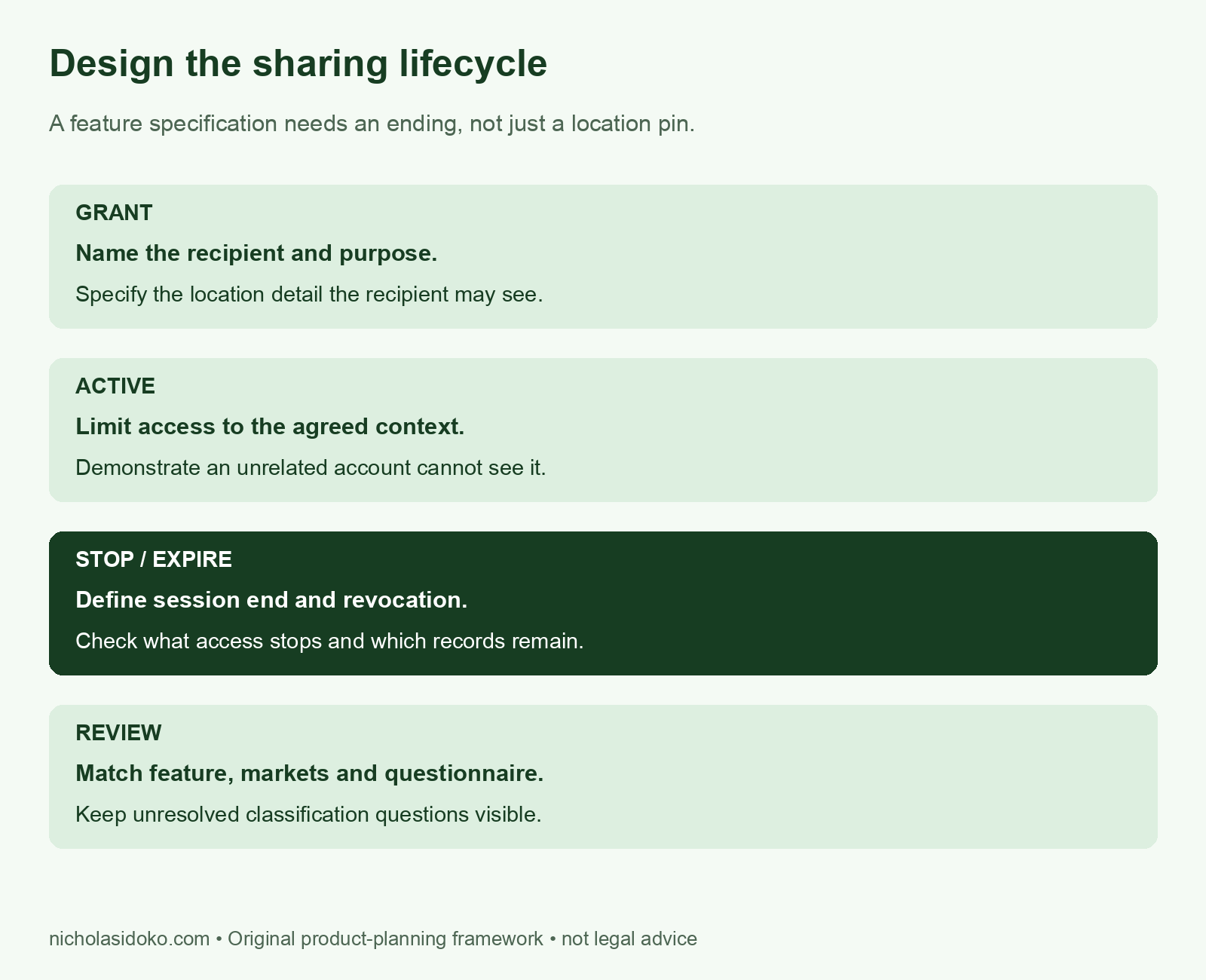
The first screen is only part of the feature. A useful scope describes what happens when a delivery ends, a recipient is removed or the person sharing changes their mind. It should also distinguish stopping live access from deleting previously retained records. Agree those outcomes explicitly rather than using “remove access” to mean several different things.
Then turn the scope into witnessed checks with test accounts and synthetic locations. Try an intended recipient, an unrelated account and an expired session. Keep the expected outcome beside the observed result. Never put real customer locations or account credentials in a public planning worksheet.
Download the App Store age rating shared location worksheets
- Location feature scope worksheet (CSV)
- Recipient access acceptance checks (CSV)
- Apple source and market boundary register (CSV)
- Blank launch-market review register (CSV)
Methodology and next step
We checked Apple’s release notes and earlier announcement on 20 November 2026. The feature examples, comparison and lifecycle are original planning tools. We have not classified a client app or tested its access controls. No user-location dataset, approval probability or rejection rate is claimed. The worksheets are for product discovery and supplier acceptance planning.
Our iOS development services start with the user journey and business requirements. If your product spans platforms, the Android handover checklist explains a separate ownership question. Tell us who needs to see whose location and where you are launching. We can help scope the feature before development; share an example design without personal location data.
Support our research
Found this report useful? Your contribution helps us produce carefully sourced research, clear charts and practical resources, freely available to everyone. Choose a one-time amount that works for you.


