A payment gateway migration checklist should prove what happens after a customer clicks, not simply that payment buttons appear. Before you retire the old checkout, agree how success, cancellation, decline, pending results, unavailable methods and re-enabled methods will behave. Then retain evidence that your business can use to decide whether the new integration is ready.
Payment gateway migration checklist: test the business outcome
Two BigCommerce fixes documented on 19 November 2026 illustrate different questions. An iDEAL cancellation through Adyen had appeared as a decline. Separately, re-enabled PayPal Commerce could display buttons but fail to start payment. The changelog describes fixes, not a current failure affecting every store.
The Flutterwave incident history supplies a third boundary. A 19 November disruption affected one Nigerian mobile-wallet option; the notice said other methods were unaffected and later recorded resolution at 22:36 UTC. None of these examples provides a merchant failure rate or evidence about a Nicholas Idoko client.
For an owner, the useful lesson is to ask a more precise acceptance question. Can a shopper understand the result, can staff decide whether to fulfil, and can the payment be traced through the agreed reconciliation process? Those three views should agree for each scenario.
Put six scenarios in the sign-off sheet
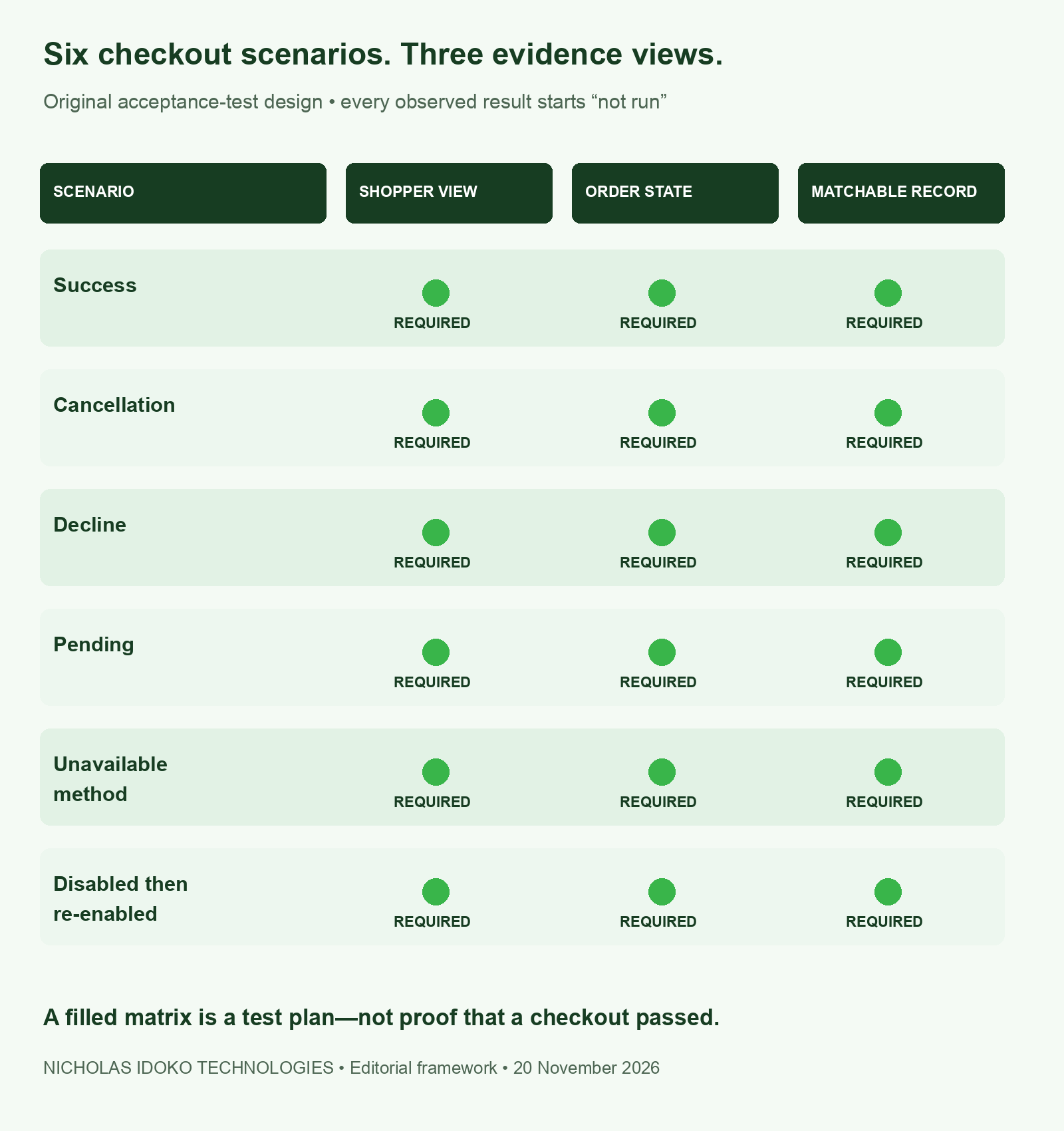
Start with a successful payment. Agree what counts as verified payment in the chosen integration and how that state reaches the order system. Record a synthetic order reference, amount, currency and provider reference. A success page alone should not become the release condition for goods or services.
Next, cancel an attempt and provoke an agreed test decline through the provider’s supported test environment. The customer should receive the right explanation, while the order remains unpaid. Cancellation and decline are different outcomes, even if both mean that staff should not fulfil that attempt as paid.
A pending result needs an explicit holding state. Ask what the shopper sees while confirmation is outstanding and how a later result changes the order. Also check that a retry or delayed notification does not trigger duplicate fulfilment. Record the agreed exception owner rather than treating a timeout as success or failure.
For an unavailable method, check the message and any offered alternative. Verify the alternative independently; its mere presence does not establish that it works. Finally, switch a method off and back on in an agreed test setup. Confirm that it starts payment and repeat the relevant outcome checks, rather than stopping when its button returns.
Separate the screen, the order and the money trail
For example, ask for a compact evidence pack rather than a recording of someone clicking through checkout. Each test should show the customer-facing result, the stored order state and the provider evidence that supports it. Keep timestamps and identifiers together so a reviewer can follow one test without confusing it with another.
Reconciliation may continue after checkout. Agree what later settlement or bank evidence will be matched, who will review it and how fees or adjustments are handled. Do not promise that every provider uses the same schedule. The point is to define the trail and expose an unexplained difference, not to invent a universal settlement time.
Agree go, no-go and rollback criteria before launch
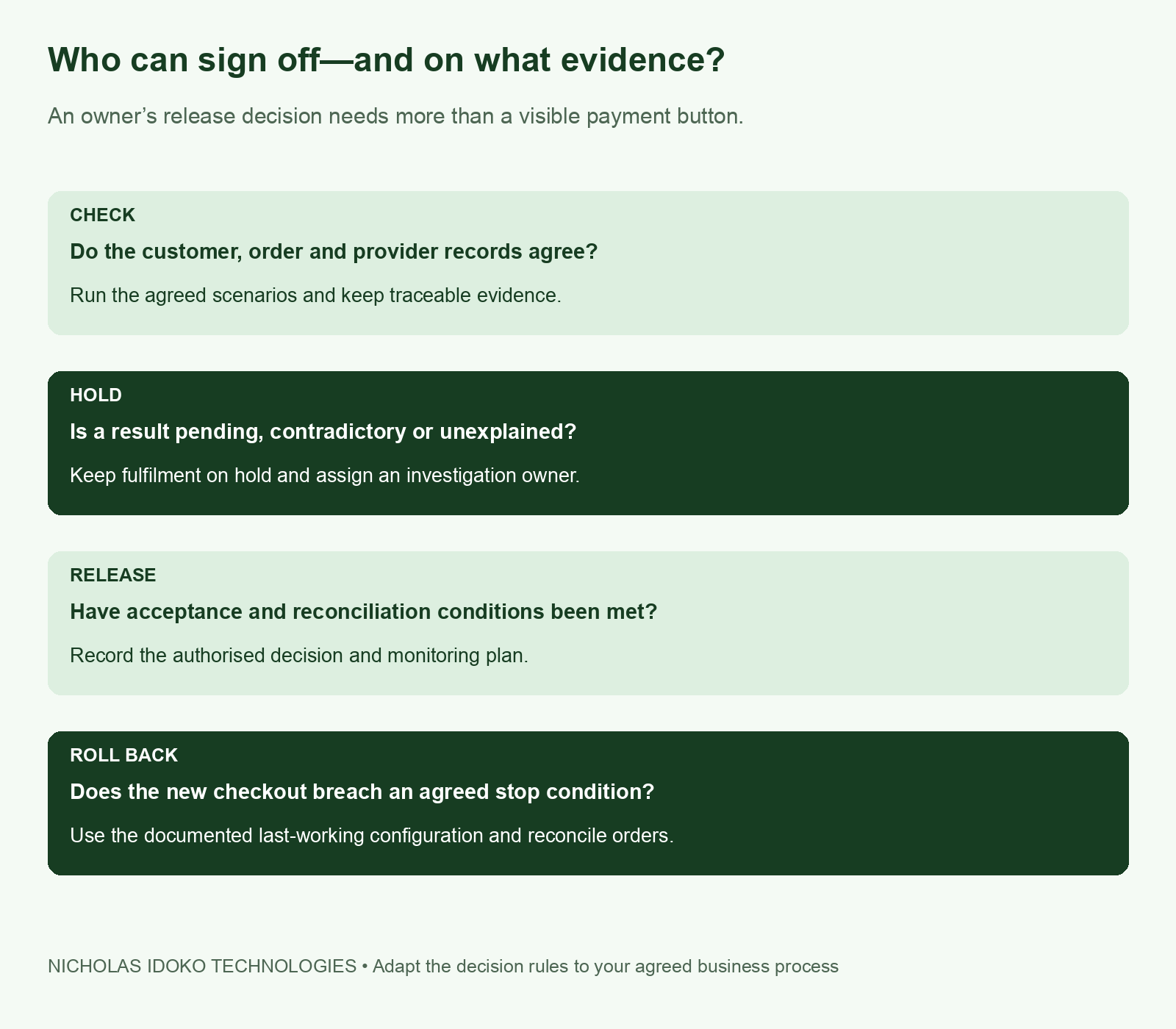
A proposal should name the acceptance owner, the required scenarios, the evidence to retain and the conditions that stop release. For example, an order marked paid despite an unverified payment result should trigger investigation. These are contract-specific acceptance rules, not a guarantee that any platform is risk-free.
Finally, your rollback plan should identify the last verified configuration, the person authorised to restore it and the handling of orders created during the change. Keep a versioned record of settings without putting passwords, private keys or payment credentials in a shared worksheet. Document how support will detect and escalate a problem after release.
Use your actual storefront to scope the work
The Nicholas Idoko portfolio includes Ladies City Cosmetics as a public storefront example. It is useful context for discussing a real shopping journey; it is not a claim that the store experienced the incidents above, uses the named integrations or has completed this test plan.
Bring your current checkout, the provider you are moving to and one example order journey. Our e-commerce development service can help scope the integration and acceptance work. The blog’s safe system migration guide separately explains why the records and rollback boundary need attention.
Download your payment gateway migration checklist
- Six-scenario checkout sign-off sheet (CSV)
- Customer, order and reconciliation evidence dictionary (CSV)
- Go/no-go and rollback decision register (CSV)
- Dated primary-source case register (CSV)
Methodology and next step
We checked the dated BigCommerce entry and Flutterwave’s incident record on 20 November 2026. The six-scenario matrix and acceptance registers are our original editorial tools. We have not run a checkout benchmark or tested a client store for this report. Empty observations mean the test has not been evidenced, not that it passed.
Share your current checkout and the provider you are moving to. We’ll help scope what needs to be tested before you switch. Send the public checkout address and a short description of the change; do not send passwords, keys or customer payment details.
Support our research
Found this report useful? Your contribution helps us produce carefully sourced research, clear charts and practical resources, freely available to everyone. Choose a one-time amount that works for you.


