


Introduction to Augmented Reality Labs and Their Role in Modern Education
What Are Augmented Reality Labs?
Augmented Reality Labs combine physical experiments with digital enhancements.
They overlay virtual objects onto real-world environments through devices.
Students interact with hands-on science through immersive augmented experiences.
This approach blends tangible and virtual scientific exploration effectively.
Importance in Modern Education
Augmented Reality Labs engage students by making abstract concepts tangible.
They foster deeper understanding through interactive and visual learning.
Moreover, AR Labs accommodate diverse learning styles and needs.
Many educators adopt AR to supplement traditional classroom experiments.
Advantages Over Traditional Methods
AR Labs provide safe environments for conducting potentially hazardous experiments.
Students can repeat experiments without extra costs or material waste.
Additionally, AR enhances student motivation and enthusiasm for science.
It also enables remote access to lab simulations for online learners.
Application Across Various Scientific Disciplines
Teachers utilize AR Labs in subjects like physics, chemistry, and biology.
Virtual tools demonstrate complex processes dynamically and clearly.
For example, students explore molecular structures or electrical circuits interactively.
Such capabilities make science more accessible and exciting for all students.
Future Prospects of Augmented Reality in Education
Technology leaders like Meridian Learning Solutions pioneer new AR lab platforms.
Continuous innovation expands AR usage beyond science to interdisciplinary fields.
Institutions increasingly invest in AR tools to modernize their curriculum.
Ultimately, AR Labs aim to transform education by merging real and virtual experiences.
Advantages of Integrating AR with Hands-On Science Experiments
Enhancing Student Engagement and Motivation
Augmented Reality captures student attention by making experiments more interactive.
It encourages participation through immersive visual and virtual elements.
Moreover, AR creates an exciting learning environment that motivates students to explore.
Consequently, learners stay focused longer and retain more information.
Improving Conceptual Understanding
AR helps visualize complex scientific concepts that are difficult to grasp physically.
For example, molecular structures and chemical reactions become easier to comprehend.
Additionally, virtual overlays can provide real-time feedback during experiments.
This integration bridges theory and practice for deeper understanding.
Providing Safe and Cost-Effective Experimentation
AR allows students to conduct potentially hazardous experiments in a risk-free setting.
They can simulate dangerous reactions without exposure to real chemicals.
Furthermore, it reduces the need for expensive lab materials and equipment.
Therefore, schools with limited resources gain access to advanced scientific explorations.
Facilitating Personalized Learning Experiences
Augmented Reality tools can adapt to individual student learning paces and styles.
Students receive customized instructions and experiment variations in real time.
This personalization supports differentiated learning and boosts confidence.
Thus, every learner can explore science concepts in a way that suits them best.
Encouraging Collaboration and Critical Thinking
AR applications promote teamwork by enabling shared virtual lab experiences.
Students work together to solve scientific problems using both physical and digital tools.
Moreover, this approach fosters critical thinking and analytical skills.
Collaborative learning drives innovation and deeper scientific inquiry.
Extending Learning Beyond the Classroom
Students can access AR labs anywhere, enabling continued experimentation outside school.
This flexibility enhances learning opportunities and encourages curiosity.
Educators can assign virtual experiments to complement traditional lessons.
Consequently, science education becomes more accessible and engaging overall.
Technologies Enabling AR Labs
Hardware Components
Augmented reality labs rely on specialized hardware to deliver immersive experiences.
First, AR headsets like Microsoft HoloLens and Magic Leap provide hands-free interaction.
These devices overlay virtual models onto the physical environment seamlessly.
Next, smartphones and tablets serve as accessible AR platforms using built-in cameras and sensors.
Additionally, motion tracking systems capture precise user movements.
Popular tracking technologies include infrared cameras and inertial measurement units.
Moreover, spatial mapping sensors analyze the environment to anchor virtual objects accurately.
These sensors use technologies such as LiDAR and depth cameras for detailed scans.
Furthermore, haptic feedback devices enhance tactile sensations during experiments.
Together, these hardware components create an interactive and realistic laboratory setting.
Software Components
AR labs depend heavily on advanced software platforms for content creation and delivery.
Unity and Unreal Engine are popular development environments for building AR applications.
These engines support 3D modeling, animation, and real-time rendering.
Moreover, AR toolkits such as Vuforia and ARKit simplify object recognition and tracking.
They integrate with hardware sensors to synchronize virtual content with the real world.
Furthermore, cloud-based platforms enable collaborative experiments across remote locations.
Data analytics software helps educators assess student performance and engagement.
Additionally, AI algorithms power adaptive learning and personalized feedback in AR labs.
Integration frameworks allow smooth communication between hardware and software layers.
Consequently, the combination of these tools ensures effective and scalable AR lab experiences.
Gain More Insights: Cloud-Powered Data Security Solutions for Protecting Student Privacy
Design Principles for Creating Effective AR Science Experiments
User-Centered Interaction Design
Designers must prioritize intuitive controls to enhance user interaction.
Clear instructions guide users through each experimental step efficiently.
Moreover, feedback mechanisms help learners understand their actions instantly.
Therefore, the interface should minimize cognitive load for better focus.
In addition, accessibility features ensure inclusivity for diverse learners.
Integration of Virtual and Physical Elements
AR experiments should seamlessly combine digital overlays with physical objects.
This integration reinforces hands-on learning with immersive virtual content.
Consequently, users experience real-time data linked to their physical manipulations.
Furthermore, consistency between virtual and real components maintains experiment credibility.
Thus, designers need precise calibration to align these elements accurately.
Engaging and Educational Content
Content must stimulate curiosity and encourage exploration of scientific concepts.
Animations and 3D models illustrate complex ideas more clearly than static images.
Also, interactive quizzes reinforce knowledge and promote active learning.
Therefore, experiments should balance challenge with achievable goals to sustain motivation.
Besides, contextual storytelling connects experiments to real-world applications effectively.
Scalability and Flexibility of Experiments
Designs should accommodate different educational levels and learning styles.
Adjustable difficulty settings help tailor the experience to individual needs.
As a result, educators can customize experiments for various classroom environments.
Moreover, modular components allow for easy updates and content expansions.
Thus, scalable designs extend the lifespan and usability of AR lab resources.
Technical Performance and Reliability
Fast loading times and smooth frame rates improve overall user satisfaction.
In addition, stable tracking prevents disorientation during experimental tasks.
Furthermore, the platform must support a wide range of devices for accessibility.
Designers must also test extensively to minimize bugs and errors.
Consequently, reliable AR experiences foster user trust and encourage repeated use.
Find Out More: Real-Time Collaboration Software for Global Classrooms and Cultural Exchange
Case Studies of Successful AR Lab Implementations in Schools and Universities
Innovative AR Integration at Brookfield High School
Brookfield High School incorporated AR labs to enhance chemistry experiments.
The science department collaborated with LuminaTech Solutions to develop custom AR modules.
Students used AR headsets to visualize molecular structures during titration experiments.
This approach helped learners understand complex concepts more easily.
Teachers noted a significant increase in student engagement and participation.
Moreover, hands-on activities combined with AR boosted retention of scientific principles.
Virtual Biology Labs at Evergreen University
Evergreen University introduced AR tools in their biology lab to simulate dissections.
The AR application, BioScope AR, provided a safe and interactive environment for study.
Students could virtually explore anatomical layers without ethical concerns or resource limits.
Professors reported the technology allowed for repeated practice, improving student confidence.
Additionally, AR helped bridge gaps between theoretical lectures and practical skills.
The university plans to expand AR use to other science departments based on positive feedback.
Collaborative AR Physics Experiments at Riverside College
Riverside College implemented AR to facilitate group-based physics experiments.
The college partnered with NexGen Labs to create interactive AR simulations for mechanics studies.
Students worked together using AR tools to manipulate virtual objects and observe physical phenomena.
This method enhanced collaborative problem-solving and critical thinking skills.
Faculty observed that students could experiment more freely without material constraints.
Consequently, the AR labs promoted deeper understanding through experiential learning.
Observed Benefits of AR Lab Implementations
- Increased student motivation and curiosity toward science subjects.
- Enhanced visualization of abstract scientific concepts.
- Improved accessibility for students with different learning styles.
- Reduced costs and risks associated with physical lab supplies and experiments.
- Greater opportunities for remote or hybrid learning environments.
These case studies demonstrate the transformative impact of augmented reality in science education.
See Related Content: AI-Enhanced Content Creation Software for Developing Educational Materials
Bridging the Gap Between Physical Lab Equipment and Virtual Tools
Integrating Augmented Reality with Traditional Experiments
Augmented reality enhances traditional lab experiments by overlaying digital information on physical equipment.
Researchers like Dr. Maya Santos at Nimbus Labs develop AR applications to support hands-on learning.
These tools allow students to visualize complex concepts in real time during experiments.
As a result, learners gain a deeper understanding of scientific principles through interactive experiences.
AR also reduces the risk of errors by providing instant guidance and feedback while using lab equipment.
Benefits of Combining Physical and Virtual Science Tools
Blending tangible equipment with virtual elements creates a more engaging and effective learning environment.
For example, Quantum Labs recently demonstrated improved retention rates among biology students using AR.
Furthermore, this approach allows safe exploration of hazardous or expensive experiments virtually before trying physical setups.
It encourages collaboration by enabling remote teams to interact with the same augmented lab environment.
In addition, virtual simulations can extend the capabilities of physical tools beyond their standard functions.
Challenges and Strategies for Implementing AR Labs
Integrating AR into existing labs requires addressing hardware compatibility and software usability.
Developers like Pulse EduTech focus on creating intuitive interfaces to lower the learning curve for instructors and students.
Moreover, balancing cost concerns with educational benefits is crucial for broad adoption in schools and universities.
Partnerships between technology firms and educational institutions help tailor AR solutions to specific curricula needs.
Ongoing training and technical support ensure educators confidently use augmented reality alongside traditional tools.
You Might Also Like: Machine Learning Algorithms for Personalized Student Tutoring
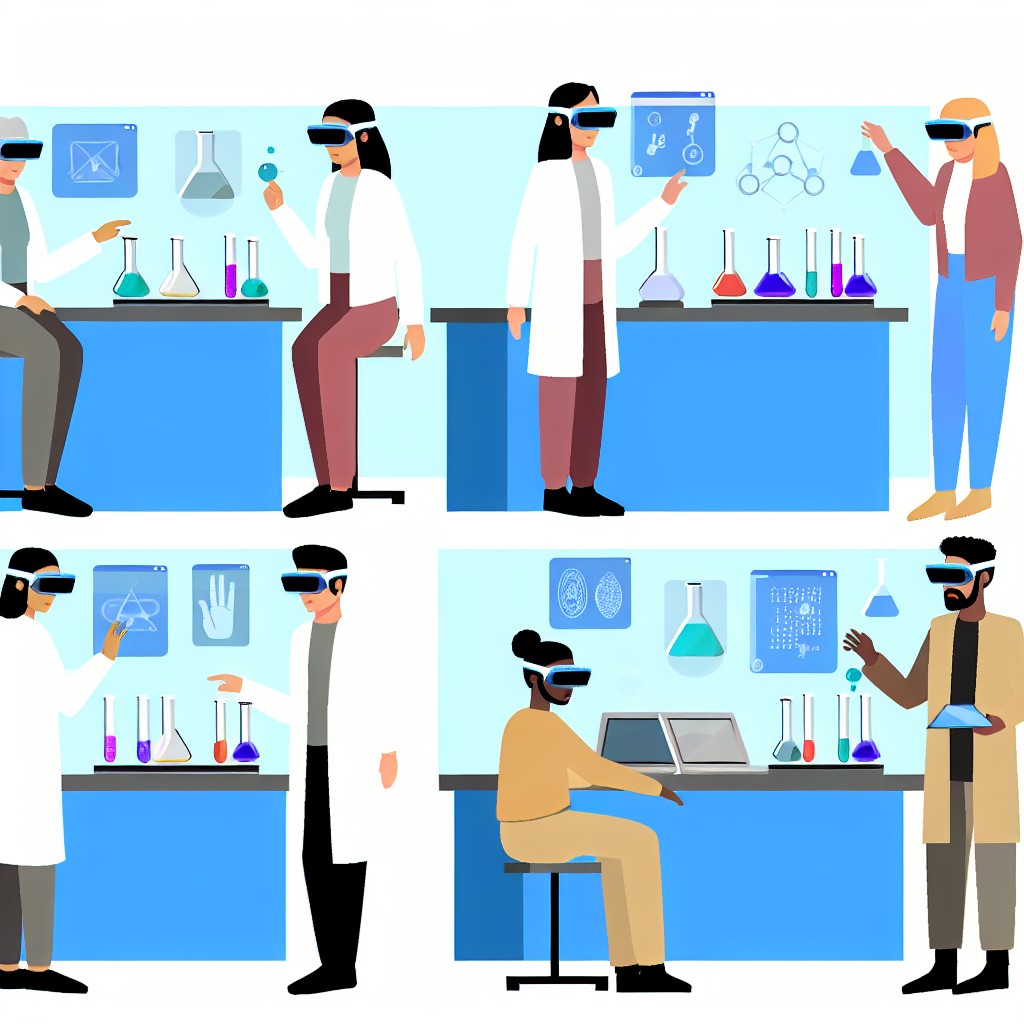
Enhancing Student Engagement and Understanding through AR Visualizations
Immersive Learning Experiences
Augmented reality (AR) transforms science labs into immersive learning environments.
Students interact directly with virtual models layered onto real-world objects.
This interaction sparks curiosity and helps maintain their attention throughout experiments.
Moreover, AR provides dynamic visualizations that clarify complex scientific concepts.
Consequently, learners grasp abstract ideas more easily than with traditional methods.
Improving Comprehension of Scientific Processes
AR enables real-time visualization of chemical reactions and physical phenomena.
Viewers observe step-by-step transformations that occur during experiments.
This detailed perspective fosters deeper understanding of experimental outcomes.
Additionally, AR tools illustrate microscopic or invisible elements effectively.
As a result, students build stronger connections between theory and practice.
Increasing Motivation through Interactive Content
Interactive AR applications motivate students to explore various scientific topics independently.
Gamified elements like quizzes and challenges encourage active participation.
Furthermore, instant feedback guides learners to correct mistakes quickly.
Teachers like Professor Lauren Mitchell report greater enthusiasm in their classrooms using AR.
Therefore, AR supports sustained engagement and drives meaningful learning.
Supporting Diverse Learning Styles
AR accommodates visual, kinesthetic, and auditory learners simultaneously.
Visual learners benefit from colorful 3D models and animations.
Kinesthetic learners engage with virtual experiments through gestures and device movements.
Auditory learners gain from integrated narration and sound effects.
Consequently, AR fosters inclusive education and helps more students succeed.
Facilitating Collaboration and Communication
AR encourages group activities where students solve problems together.
Shared virtual environments promote discussion and idea exchange.
Teachers like Dr. Carlos Ramirez use AR labs to strengthen teamwork skills.
In addition, AR platforms often allow remote participation, bridging distance gaps.
Thus, augmented reality cultivates collaboration and improves communication abilities.
Examples of Effective AR Tools in Science Education
Companies such as LearnSphere and InnovateEd develop cutting-edge AR science platforms.
These applications offer interactive simulations for biology, chemistry, and physics experiments.
For instance, LearnSphere’s CellScope app reveals cellular structures in 3D detail.
InnovateEd provides AR chemistry sets that simulate molecule formation safely.
Such tools enable educators to enrich curricula and boost student comprehension.
Challenges and Limitations in Deploying AR Labs for Science Education
Technical Barriers and Infrastructure Requirements
Deploying augmented reality labs requires reliable and modern hardware.
Many educational institutions lack access to AR-compatible devices.
Stable high-speed internet is essential for seamless AR experiences.
Without this infrastructure, students face frequent interruptions and lag.
Integrating AR technology with existing IT systems demands technical expertise.
Schools often struggle to maintain and update AR software efficiently.
Cost Constraints and Budgetary Challenges
AR labs involve significant costs for hardware, software, and licensing.
Many school districts operate within limited budgets, restricting AR adoption.
Ongoing expenses include software updates and technical support.
These costs often compete with funding for traditional laboratory equipment.
Consequently, schools prioritize essential resources over emerging AR technologies.
Teacher Training and Curriculum Integration
Effective AR lab use depends on adequately trained educators.
Many teachers lack experience or confidence with augmented reality tools.
Professional development programs are necessary for skill building.
Time constraints hinder teachers from attending extensive training sessions.
Curricula require adjustment to include AR activities meaningfully.
Without clear guidelines, educators struggle to link AR labs with learning objectives.
Student Accessibility and Equity Concerns
AR labs may exacerbate educational inequalities across different student populations.
Not all students have equal access to compatible devices outside school hours.
This disparity limits continuous learning and practice opportunities.
Students with disabilities might face challenges using AR tools.
Designers must consider accessibility features to support all learners.
Content Development and Scientific Accuracy
Creating high-quality AR content requires collaboration between educators and developers.
Ensuring scientific accuracy in virtual experiments is critical for learning effectiveness.
Rapid AR content production sometimes sacrifices depth and rigor.
This compromises students’ understanding of complex scientific principles.
Regular updates are essential to keep content aligned with current standards.
Future Trends in Augmented Reality Labs
AI Integration Enhancing AR Labs
Artificial intelligence increasingly powers augmented reality lab experiences.
It simplifies data analysis during hands-on experiments.
Moreover, AI customizes learning paths for individual students.
For example, QuantumVision Systems uses AI to adapt AR simulations dynamically.
This integration boosts engagement and understanding of complex concepts.
Additionally, AI assists in real-time error detection during experiments.
It offers guided corrective feedback to improve student performance.
Furthermore, machine learning models predict experiment outcomes to aid decision-making.
Collaborative Augmented Reality Lab Environments
Collaborative AR environments foster teamwork among students remotely.
Institutions like Horizon Labs develop multi-user AR spaces for group experiments.
These platforms allow real-time interaction inside virtual laboratories.
Consequently, learners share insights and troubleshoot collectively.
The immersive collaboration bridges geographical and resource gaps effectively.
Also, teachers monitor progress and provide support across virtual groups.
Integration of voice and gesture controls enhances natural communication.
Ultimately, this promotes deeper understanding through peer learning.
Innovations Shaping the Future of AR Labs
Emerging sensor technology improves realism in virtual experiments.
Tactile feedback devices simulate physical sensations during AR activities.
Companies like AeroOptix pioneer haptic gloves for precise manipulation in labs.
Moreover, cloud computing enables seamless data storage and access.
It supports complex simulations without hardware limitations locally.
Furthermore, AI-driven analytics deliver insights for educators to refine curricula.
Collaborative efforts between developers and educators ensure practical solutions.
These innovations collectively drive the evolution of AR lab experiences.
Best Practices for Educators to Adopt and Innovate with AR Labs
Preparing for an Effective AR Lab Integration
Educators should first understand the core objectives of their science curriculum.
They must then evaluate how augmented reality (AR) can enhance those learning goals.
Next, gathering input from colleagues familiar with AR tools helps shape the implementation plan.
Additionally, familiarizing themselves with available AR platforms ensures proper tool selection.
Teachers should also consider student accessibility to technology before launching AR labs.
Choosing the Right AR Tools and Content
Selecting AR applications that align tightly with lesson topics improves student engagement.
Furthermore, tools offering interactive simulations encourage deeper understanding of scientific concepts.
Educators should seek user-friendly interfaces to minimize learning curves during labs.
Collaboration with developers like Meridian AR Solutions can provide custom AR content tailored to class needs.
It is important to ensure the AR tools support multiple devices for flexible classroom use.
Designing Interactive and Inclusive AR Lab Experiences
Teachers must create lab activities that combine hands-on experiments with virtual AR elements.
They should encourage students to manipulate virtual models to enhance experiential learning.
Integrating group work promotes collaboration and diverse viewpoints during AR investigations.
Providing step-by-step guidance helps students navigate complex AR tasks confidently.
Educators also need to accommodate students with different learning preferences and abilities.
Training and Supporting Educators for AR Labs
Schools should organize professional development focused on AR technology best practices.
Mentorship from experienced AR educators like Dr. Mia Reynolds boosts teacher confidence.
Ongoing technical support reduces disruptions during AR lab sessions.
Sharing success stories within faculty encourages innovation and continuous improvement.
Moreover, establishing forums for feedback helps refine AR lab strategies effectively.
Evaluating and Improving AR Lab Implementation
Collecting student performance data measures the impact of AR enhancements accurately.
Surveys and reflections provide insights into student engagement and comprehension.
Educators should analyze what worked well and identify areas for improvement.
Regularly updating AR content keeps lessons relevant and challenging.
Finally, remaining adaptable ensures AR labs evolve with advancing technology and educational standards.
Additional Resources
VR and AR for Hands-on STEM Education – Filament Games
Digital learning platforms in aircraft maintenance technology …
Before You Go…
Hey, thank you for reading this blog post to the end. I hope it was helpful. Let me tell you a little bit about Nicholas Idoko Technologies.
We help businesses and companies build an online presence by developing web, mobile, desktop, and blockchain applications.
We also help aspiring software developers and programmers learn the skills they need to have a successful career.
Take your first step to becoming a programming expert by joining our Learn To Code academy today!
Be sure to contact us if you need more information or have any questions! We are readily available.
We Design & Develop Websites, Android & iOS Apps
Looking to transform your digital presence? We specialize in creating stunning websites and powerful mobile apps for Android and iOS. Let us bring your vision to life with innovative, tailored solutions!
Get Started Today